Maintenance Toolkit
Walking Pad Maintenance & Repair
Jun 21, 2025 As an Amazon Associate I earn from qualifying purchases.
Everything that goes wrong with a walking pad traces back to heat and tension. Prevent both with a simple maintenance routine - warm-start, de-dust, lubricate, adjust - and when something does break, a full-sweep repair guide walks you through drive belts, bearings, and reassembly.
Compare every walking pad we track - Vitalwalk, Jogwell, Office Walker, SB Fitness Equipment, Walkolution, and more - on price, motor, warranty and noise.
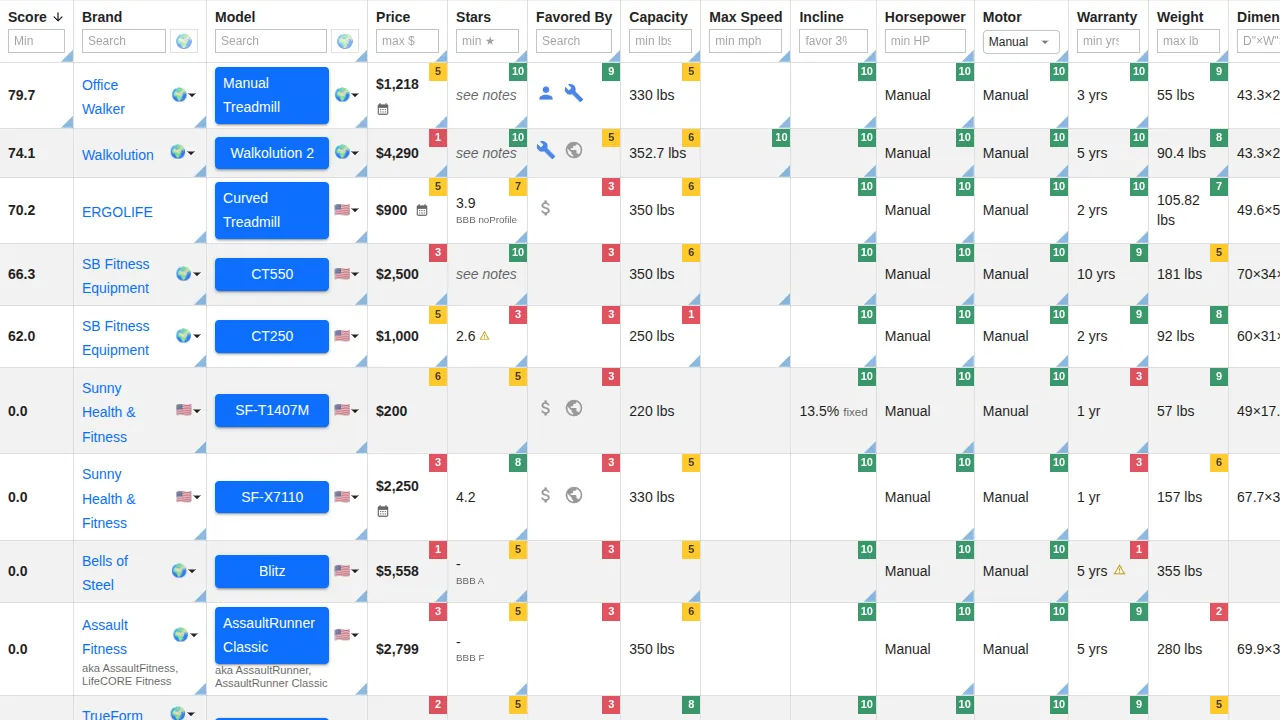
Open the full comparison table →
Everything that goes wrong with a walking pad traces back to two enemies: heat and tension. Heat from poor ventilation or dust buildup degrades the motor. Tension from friction, over-tight belts, or seized bearings destroys the drive belt, then the motor. Every maintenance ritual below targets one or both. Budget mills need repair around 6 months, value mills around a year, premium mills at 2+ years. Manual treadmills need almost none.
Maintenance
Warm-start before stepping on every use
VideoNever stand on the belt when you press start. Starting the motor with your full weight forces it to overcome your inertia from a dead stop, creating a surge of current - locked rotor amperage - that can fry the controller board on cheaper units. Always step onto the side rails, press start, and wait until the belt is moving before stepping on.
For the first use of each day, take it further: run the belt 1-2 minutes at max speed before stepping on. This expands the drive belt's ribbing for a better grip on the pulley. You only need this extended warm-up once per day.
Walk 30-45 min, break 5 min every session
VideoHeat accumulates in the motor chamber during use. Walk 30-45 minutes, then take a 5-minute break to let it dissipate. That split is my own rule, not a manufacturer spec - what manufacturers actually publish is thinner than you'd think. The occasional hour won't kill the machine, but running the belt 8 hours straight will. The Pomodoro Technique (25 min work, 5 min break) maps perfectly to this. If you use the open casket technique, this constraint relaxes significantly.
De-dust the motor chamber weekly
VideoDust, pet hair, and debris accumulate in the motor chamber and cause heat buildup. Blow air through every vent and opening with a high RPM electric duster (see toolkit). If you use the open casket technique, this is easier and less critical since debris doesn't get trapped.
Lubricate the walking belt every 40h of use
VideoFriction between the walking belt and the deck is the biggest source of tension on your drive train. Apply silicone lubricant (see toolkit) in a zig-zag motion under the belt, especially near the center, then run at low speed for 2 minutes without stepping on. The 40-hour rule is a starting point - the real test is feel. Reach under the belt: oily and slick means you're good; dry means it's time. Different decks absorb lube at different rates, so the feel test is more reliable than a timer. Use a bottle with a long, stiff applicator tube, not the dropper that ships with the treadmill.
If you store your treadmill upright, gravity pulls the lube down toward the motor chamber. This pools oil where you don't want it and starves the deck where you do. Keep it flat if you can; if you must store upright, check deck dryness more often.
Adjust the belt as needed
VideoThe belt will drift to one side periodically - this is normal, happens at least once a week with every treadmill. Fix it with the included Allen wrench: slightly tighten the side that's too tight (no gap), and slightly loosen the slack side. You're meeting in the middle - pulling the rolling pin closer on the tight side creates a slope the belt rolls down. Quarter turns while the belt is running, wait 15 seconds, repeat until centered.
While you're at it, check belt tension. Lift the walking belt at the center of the deck - it should come up about 2-3 inches. Less than 2 is too tight (strains the drive train); more than 3 is too loose (causes slippage). A sloppy belt-adjustment leads to early motor, bearing, or drive-belt failure by putting uneven strain on the system. Signs: jerky motions, squeaking, grinding, smells.
Is it normal for a walking pad to get hot?
Warm is normal, and there's a design reason these run warmer than you'd expect. Conventional treadmill motors carry their cooling fan on the motor's own drive shaft, so airflow falls off with belt speed - the cooling is weakest at exactly the moment a heavier walker at low speed is demanding the most torque from the motor. That catch-22 is spelled out in the background of US Patent 6,478,720, and walking-pad speeds sit in that worst case all day long. Whether any particular compact pad copies that shaft-mounted arrangement isn't something manufacturers document, but the enclosure problem is the same one the motor guide covers: a thin sealed chamber has far less air to work with than a full-size treadmill.
There is no published number for "too hot." No manufacturer states a temperature for the housing or the deck, and manuals surface heat only as a fault code - KingSmith's E03 is just "IPM module overheating." What they publish instead is a session limit: KingSmith tells owners not to walk more than an hour at a stretch and to rest the machine before restarting, and plenty of budget pads publish nothing at all. Ignore the "30-60 minute duty cycle" figure that circulates online; it doesn't trace back to any manufacturer.
So judge it by symptoms, not degrees. A casing that's warm after a session, no smell, belt holding speed - that's the machine doing its job. My rule of thumb for the other side: too hot to rest your hand on, a burning or hot-plastic smell, the belt slowing or stuttering under your weight, or a unit that cuts out mid-walk and runs fine once it's cooled. That's heat it can't shed, and all three fixes are above - de-dust the chamber, lubricate the deck, and back belt tension off to the 2-3 inch lift. Under-lubrication is the usual culprit, because friction the deck should be shedding becomes load the motor has to carry instead. Still hot after all three, and the enclosure itself is the limit - which is what the open casket technique solves.
Repair (Full Sweep)
Everything above is prevention. But when something actually goes wrong? Don't try to patch one thing. Sweep the entire system.
Warning Disassembling your treadmill may void the warranty. If you're inside warranty, consider replacing the mill instead. I personally tear mine apart regardless, more eco.
What to look for
Any of these means it's time for a full sweep. The symptom tells you the likely culprit:
- Burning rubber smell, screeching, jerky belt motion - drive belt. Most common, cheapest fix. The belt's ribbing is frayed and slipping over the pulley.
- Grindy, rocky, gravelly sounds - rolling pin bearings. Less common, harder to fix. Bearings have seized from rust or debris.
- Burning machinery smell, smoke, error codes - motor or controller. Rare if you maintain properly. Warranty territory for budget mills.
Drive belts go first
No matter what the underlying cause, your drive belt is almost certainly shot. It's the weakest link (just a band of rubber) and the most sensitive part to anything wrong in the system. A bad drive belt is the symptom rather than the disease; but if you let a slipping drive belt go too long, the motor's next. So: replace the drive belt and fix the root cause, all together.
Since replacing the drive belt means taking the whole thing apart anyway, you might as well sweep everything while you're in there.
1. Take the whole thing apart
Unscrew everything:
- Motor chamber: unscrew, take apart, careful with the wires and hot-glue.
- Back rolling pins: take the tightening screws all the way out.
- Front rolling pin: first, measure (to a millimeter) the distance between the screw-head and the axle. You'll want this perfectly aligned when you re-assemble. Take that screw out, then pull the pulley and rod through the drive belt, and out of the walking belt.
- Now remove the back rolling rod.
2. Order a new drive belt
Note the model number printed on the outside of the belt, and count the number of ribs (ridges) on the inside. For reference: the SpaceWalk 5L ships with a 5-rib belt; CyberPad Home ships with a 6-rib belt (Vega EPJ292).
Upgrade your rib count. The pre-installed belt often has fewer ribs than the pulley has grooves - manufacturers bulk-order one belt size across models to save money. The 5L ships with 5 ribs on an 8-groove pulley; the SpaceWalk 3S and CyberPad ship with 6 ribs on 8-groove pulleys. More ribs = more grip, less slippage, longer life. Count the grooves on your pulley and order a belt to match.
One tradeoff: a stock under-ribbed belt acts as a canary. It slips and fails before the motor does, giving you a cheap warning sign. An upgraded belt grips better and transfers more torque, which is healthier overall, but it means you need to stay on top of maintenance - the motor won't get the same early warning buffer if something else goes wrong. I still recommend upgrading.
You won't find these on Amazon or eBay. Search AliExpress for your model number (e.g., "PJ356"). $5-15, 2-3 weeks shipping from China. Order 2 or 3 while you're at it - the drive belt is always the first part to go, and you don't want to wait for shipping when the next one wears out.
Prove it to yourself: run your finger across the inner side of the old belt. Black powder? The rubber's falling apart. Too much strain from something below caused slippage, then degradation. Sometimes you can actually see the worn ribs, but soot alone is proof enough.
Pro tip: when you first receive any new treadmill, open it up, grab the drive belt model number, check the pulley groove count, and order a replacement immediately. Have it ready before you need it.
When the upgraded belt seizes instead of slips
If you just installed a belt with more ribs than the one that shipped, and the drivetrain locks up solid the instant you put weight on it - not slipping, not jerky, just a dead stop - you traded one problem for another.
My theory: cheaper, underpowered mills intentionally ship a belt with fewer ribs than the pulley has grooves so it can slip under load instead of stalling - a deliberate slip margin, not a defect. Upgrading to the pulley's full groove count (above) removes that margin. On an underpowered motor, or with tight roller-pin bearings, the full-grip belt can out-grip the motor and seize the drivetrain instead of slipping.
Triage in this order: (1) loosen the walking-belt tension well beyond the normal 2-3 inch spec, lubricate the deck, and retest. (2) Still seizing? Re-order a belt matching the original shipped rib count instead of the pulley's groove count, and accept more frequent replacement (every 3-6 months) as the tradeoff. (3) Stopgaps that worked for me once: upgrade the roller-pin bearings, run the belt looser than usual, manually stretch the new belt before installing, and run the pad unweighted ~30 min/day until it breaks in and stops seizing.
3. Clean everything
While everything's open, clean it all down:
- Walking deck: with the belt loose, clean the deck thoroughly with old rags first, then finish with a microfiber cloth. Regular rags leave pills (lint fibers) behind that create friction - microfiber doesn't. Silicone lubricant traps dust over time, forming an abrasive sludge that wears the deck down. This buildup takes 6-12 months, but it happens. Remember to fresh-lube when you've put the mill back together, because it'll be bone dry.
- Pulleys: clean between the grooves of both the motor and rolling-pin pulleys with a damp cloth (warm water). Soot accumulates in the grooves and causes slippage. Keep going until the cloth comes away clean - it takes several passes. If you put a new drive belt over dirty grooves, it'll slip immediately.
- Rolling pins: check around the bearings and axle for pet hair, dust, and debris. Snip and remove anything there.
- Motor chamber: de-dust thoroughly, wipe down stray lube and oil. Debris and oil compound heat accumulation.
4. Check the rolling-pin bearings
Hope and pray this isn't it, because replacing rolling-pin bearings is seriously un-fun. You'll know right away: twist the axle ends clockwise and counter-clockwise with your fingers. Smooth and quiet? You're good. Grindy and jerky? You found your problem.
The model number is stamped on the bearing face. Order stainless steel ZZ replacements - e.g., if yours says "6201 2RS", order "S6201ZZ" (S = stainless, ZZ = smoother seal type). The main cause of bearing failure is rust from humidity or sweat. If you walk fast enough to sweat, your sweat lands on the belt, drips through the gap, and corrodes the bearings over time. Stainless steel solves this permanently. The full video below walks through the replacement procedure.
5. Replace the drive belt and re-assemble
Install the new drive belt and put everything back together. The full video below walks through the entire process.
This is the most important part: tighten everything perfectly.
- Front rolling-pin alignment. Millimeter-level perfect. Even a few millimeters off causes uneven strain on your drive belt, pulley, motor shaft, and bearings. There's often a notch indicating where the pin should align. It's highly probable that misalignment was the problem all along. Even though you measured before disassembly, gut-check how centered this rod is after re-installing.
- Back rolling-pin tension. You'll adjust these back screws constantly during use (you've done this before). But what matters: not too tight. Litmus test: lift the walking belt at the center of the deck. It should come up about 2-3 inches. Less than 2 inches is too tight; more than 3 is too loose. Excessive belt tension strains the pulley system, leading right back to drive belt woes, then sounds, smells, jerky motion, then motor problems.
Post-reassembly alignment: run the belt at the slowest speed first. At low speed, every quarter-turn adjustment is visible and you can correct before doing damage. Go back and forth between front and back until the belt tracks centered. Once stable, crank up the speed - faster belt makes small misalignments obvious. If the belt drags against a side at any point, stop and correct immediately; dragging frays the walking belt, which is expensive and hard to replace.
Alignment and tension were likely the problem all along (if it wasn't busted bearings). By re-assembling with care alongside replacing the drive belt, you likely just fixed your treadmill.
6. The open casket technique
Caution This is a fire hazard, an electrical hazard, and dangerous for pets and children. Proceed at your own risk.
I personally do not put the motor chamber back together. I leave it off permanently. No matter how many air holes a motor chamber has (and sometimes they seriously don't have enough), there's no better ventilation than no enclosure at all. This eliminates heat accumulation, means you can walk as long as you want without cooldown breaks, and gives you direct access for de-dusting.
It also reduces debris accumulation. Seems counter-intuitive, since you're exposing it to the elements. But think of it like this: a bird that gets into your house through a crack in the window will struggle to find its way out. A bird that came through an open garage door has no trouble leaving. Dust and hair kick back out as fast as they come in.
When to skip this: if your treadmill already has excellent ventilation - large slats, motor mounted underneath with plenty of clearance - you may not need it. My rule of thumb: motor on top with minimal vents = open casket. Motor underneath with generous airflow = probably fine as-is.
What I do with all my mills on day one: remove the motor chamber casing, grab the drive belt model number and pulley groove count (see step 2), and leave the plates off permanently.
If it's none of these
If a motor dies, it'll be obvious: smoke, an error code on the console, or the device simply refuses to start. On a budget mill, just use your warranty - motors cost about as much as the treadmill when purchased individually. On a LifeSpan or Unsit, it's worth replacing (and they'll likely cover it). If you maintain your walking pad properly, motor failure is unlikely. Always buy brushless motors over brushed: they run cooler, generate less heat, last significantly longer, and don't produce sparks from carbon brushes.
The controller board (PCB) can occasionally fail - the board that takes input from your remote and drives the motor. This is rare, and some manufacturers will send a replacement board. If yours fails, contact the manufacturer before giving up.
If you crack the deck, use your warranty. If you've worn through the walking belt, congratulations - that takes a long time. Unfortunately, walking belts are model-specific and hard to source for budget brands. LifeSpan sells replacements per model number, but for budget mills, finding the right dimensions is difficult. I've never had to replace one. If you solve this for your model, share what you found (see below).
Repair Toolkit
Only needed when things go wrong. Model-specific items are linked for the Urevo 5L; find the right parts for your model.
Drive Beltmodel-specific
$5
PJ356 8-rib for the 5L. Order proactively, have one ready before you need it. Read your belt's model number and match your pulley groove count.
Stainless Steel Bearingsmodel-specific
$9
S6201ZZ for the 5L. Check the model on your bearings and search (or ask AI) for a stainless ZZ match.
Stainless Steel Screwsmodel-specific
$6
For the 5L back rolling pin. Match your model's screw size.
Impact Socketmodel-specific
$8
For pressing bearings in without damaging the inner ring. Sized for the 5L, match your bearing's outer diameter.
Snap Ring Pliersessential
$35
Reversible/expanding type, for removing bearing snap rings.
- Plus: clean rags, microfiber cloth, tweezers (for hair wrapped around axles)essential
Rubber Malletessential
$10
WD-40essential
$8
For loosening rust inside the rolling pin tube during bearing removal.
Rubbing Alcoholoptional
$10
For cleaning oil and residue off surfaces.
Help build the database
If you open up your treadmill, I'd love your specs. Comment on the video or post on r/walkingdesks with your treadmill model and any of these you can find: drive belt model number and rib count, pulley groove count, bearing model number, and motor details (especially wattage). I'll add them to the comparison table so the next person doesn't have to tear theirs apart just to find part numbers.
Wow, that's a lot
Treadmills are needy. Budget mills more than premium. But don't let the internet fool you - LifeSpans die too without proper maintenance, I've seen it plenty. If you want a low-maintenance walking pad, get a manual treadmill. The maintenance becomes a muscle-memory ritual, and it accounts for most of the 5-star vs. 1-star discrepancy you see in reviews.