Best Manual Walking Pads 2026
Manual walking pads compared: Office Walker (the Walkolution alternative), SB Fitness CT250, Walkolution 2 and the discontinued RongLe. Motorless, non-electric, prices and specs.
Compare every manual and motorless walking pad we track - Office Walker, Walkolution, RongLe, SB Fitness - on price, frame, warranty and step-up height.
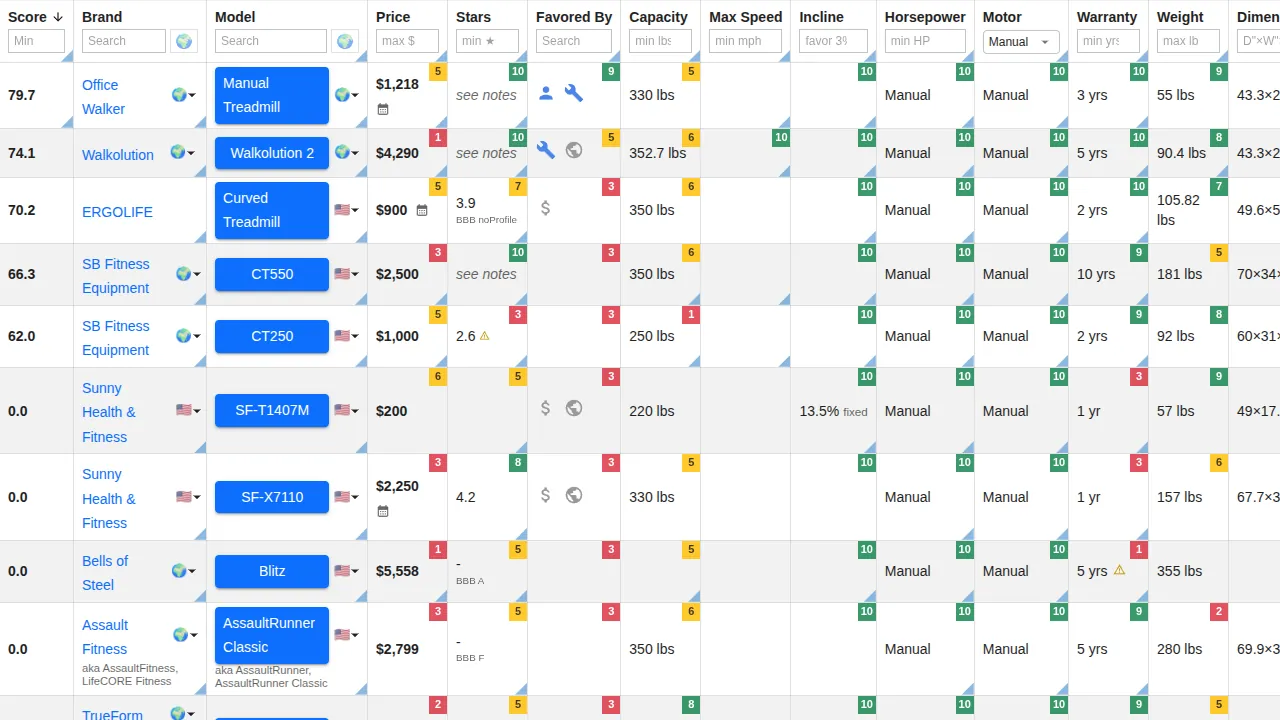
Manual walking pads - also called motorless, non-electric, non-motorized, mechanical, self-powered, or self-propelled walking treadmills - use your footsteps to move the belt. No motor, no electricity, almost no maintenance. They cost more upfront ($1,000 to $5,000+) than electric pads, but no motor means nothing to burn out, no drive belt to lubricate, and a service life measured in decades. The category was thin and pricey for years, with Walkolution the German-made benchmark at $2,900+. Then in 2025-26 two Amazon entries (ERGOLIFE at ~$900, RongLe at ~$700) briefly pulled the floor under $1,000 for a credible Walkolution alternative. Both are now discontinued. We've kept the RongLe review below as the record of what that money bought, but the cheapest manual you can actually order today is the SB Fitness CT250 at ~$1,000, and the $700 floor is gone.
Best Manual Walking Pads for Under-Desk Use
Four products belong in this category for 2026, and two of them can be ordered today: the SB Fitness CT250 and the Walkolution 2 on its standard slats. The Office Walker is a Kickstarter late pledge whose first units are shipping now, and the RongLe QZD-103-XJ is discontinued. Its entry below is kept as reference, not as a recommendation. Gym-tier curved treadmills like AssaultRunner and Bells of Steel surface in "manual treadmill" searches but are built for sprint training, not desk walking - see not recommended for desk use below.
Office Walker: The Walkolution Alternative
The cleanest Walkolution alternative on the market. A motor-free walking pad with a wood frame and modular soft-touch slats over a friction-balanced drivetrain (provisional patent filed) - same slat-on-bearings physics as Walkolution, in an under-desk form factor, at roughly a third of the price.
44.9" x 21.3" x 8.3" with a 17.7" walking width, 55 lb, 5.5" step-up height, 330 lb max user (tested at Intertek Nuremberg), 33-45 dB. It ships assembled, in five finishes: Brown and Gray, Natural and Gray, Natural and Light, All Black, and Black and Light. The Kickstarter closed on December 2, 2025 at EUR 897,163 from 892 backers, and late pledges have since taken it past 2,043. Those late pledges are still the only way to order, from EUR 1,149 (~$1,471) before tax and shipping, and a pledge gets no 30-day return. Wheels at the base let you park it vertically against a wall.
The first units are shipping now, and Office Walker's own store is due in early January 2027. Nobody has published an independent review yet, so you'd still be buying an untested product. Coverage is five years on the complete machine, plus free replacement of wear parts that wear out through no fault of yours.
Johannes Kettmann and his team are active on Discord and respond to backer feedback - the current drivetrain resistance came directly from prototype-stage Reddit testers reporting the early version was too high for sustained desk work.
If you've been priced out of Walkolution, this is the pick. Don't want to wait on a pre-order? The SB Fitness CT250 is the steel curved-belt alternative you can buy today.
SB Fitness CT250
The cheapest credible steel curved-belt manual you can order - 50" x 16" running surface, 250 lb max user, 5-year frame / 2-year parts warranty backed by SB Fitness (a real US-based reseller, not an Amazon white-label). Owners report you can skip the medical-handrail installation during assembly, turning it into an under-desk pad with a 7.5" step-up height, and SB Fitness puts the rails-off base at 51" x 23". The console normally mounts on the upright; without the rails, SB Fitness says you can unplug its data cable and set the console on your desk, or leave it off, since the machine runs without it. The brand told us it doesn't know of anyone who has done it. It also estimates about 60% of CT250 buyers use it under a desk.
SB Fitness permanently pulled the CT250 from Amazon in September 2026. It's sold direct from SB Fitness's own store at sbfitnessequipment.com, at $1,045 on sale ($1,995 list) as of October 2026.
The mid-tier CT550 ($1,995 on sale, $2,995 list) has bolt-on uprights, a display-only console and 8 magnetic resistance levels. Leaving the rails off costs you the resistance control, a bar on the right handrail whose cable runs down the upright. SB Fitness says the magnets then drop to the lowest setting, so it still walks, just with no way to add resistance. With that and an 11" step-up, the CT250 stays the desk pick in this lineup. The heavier CT700 ($2,595 on sale, $3,695 list) is the sprint and sled-push sibling, and its rail-mounted resistance handle doubles as the brake, so rails-off it also loses the brake.
RongLe QZD-103-XJ: Discontinued, Was the $700 Floor
For about a year this was the lowest-priced manual on the market, and the reason this page could say the category started at $700. It's a curved steel-deck manual like the SB Fitness, but with a rubber-track upgrade: RongLe's original bare-steel slats swapped for rubberized ones. (Retailers list it as the QZD-103 with an upgraded rubber track; "-XJ" is shorthand for that rubber revision, not a SKU printed on the listing.) The earlier bare-steel version drew rough reviews - 2.3 stars on Amazon - and this rubber-track revision was largely unreviewed as of early 2026. 52" x 24" x 43", 300 lb max user, a 51" x 16" rubber track, an LED readout that doubles as a phone stand, ships folded with no assembly.
The catch is the thin track record: RongLe has no BBB or Trustpilot footprint, independent review volume on the rubber revision is still minimal, and while RongLe advertises a 2-year whole-machine warranty on its own site, the Amazon listing restates no manufacturer term - only a paid third-party protection plan. The strongest signal so far is a Reddit owner reporting 25,000 to 35,000 steps a day at a standing desk over several months with no failures, walking hands-free. The side rails are present but reportedly unused, and whether they fully detach is unconfirmed, which is why it scores a notch under the rail-free wood pads.
Availability: discontinued. The Amazon listing still renders in full - title, photos, and its 5-star rating pool - but it has shown "Currently unavailable" with no featured offer on every check since 2026-08-02, about 25 days as of 2026-08-27. That shape is worse than a dead link: the page looks like it works, so the only thing missing is the button. RongLe's own catalog carries the QZD-003 and R-series and no QZD-103 at all, and the brand's website is derelict - its product index 404s, its homepage lineup renders "No products found", and one live tile still ships Lorem ipsum placeholder text. There is no second channel and no successor: a larger, pricier RongLe manual is orderable on Amazon at $1,399, but it's 10 inches taller, 55 lb heavier, adds 8-level resistance the QZD-103-XJ never had, and its own bullets sell sprinting - a different machine, not this one at a new price.
The $700 floor was real, and it's gone. We're leaving the review up as the record of what the bottom of this category looked like, but with it discontinued, the cheapest manual you can actually order is the SB Fitness CT250 at ~$1,000.
Walkolution 2
Engineered in Germany from solid beech wood; under 34 dB at slow speeds, one of the quietest pads ever made (electric or manual). TheraFloor Standard slats are the right surface, though they are sold out for now; the in-stock build uses Walkolution's own Standard Slats, which the store labels "Upgradable to TheraFloor". Skip the TrueTerrain upgrade, which Reddit reports is harsh enough to make sustained work uncomfortable for some users.
The base config runs $2,995 on Walkolution's US store (October 2026), and TheraFloor surfaces start at $5,795. It's still a great machine and a defensible buy-it-for-life if budget isn't a factor and you specifically want German beech. The Office Walker at roughly half the price narrows the everyday desk-walking gap more than the price gap can justify. Stock as of October 25, 2026: every Standard Slats build is orderable, and every TheraFloor build is sold out.
Compare Every Manual Walking Pad
Every manual pad above - plus the gym-tier deterrents below - is scored and sortable by price, weight, warranty, or any spec.
How Non-Electric Walking Pads Work
A self-powered manual treadmill converts your stride into belt motion. There are two independent design axes: frame material (wooden vs steel) and propulsion geometry (subtle slat-curve, deep belt-curve, or flat-with-incline). The combinations split the market into three distinct categories.
Wooden manual walking pads (Walkolution, Office Walker)
Birch or beech slats over ball-bearing rollers, with a subtle concave profile so foot strike lands ahead of your center of mass and gravity converts it into belt motion. Walkolution 2 has a "gently curved deck" - a few degrees of slat-profile concavity, not the deep U of a gym curved-belt. Office Walker uses the same slat-on-bearings approach in an under-desk form factor (5.5" at the low point) and behaves the same way to walk on.
This is the desk-walking tier: low step-up height, slow-speed friendly, quiet enough for phone calls. Search results for "wooden walking pad", "curved manual treadmill", and "manual walking pad wooden" all converge on these two products for the same physical reason - the curve is subtle, the slats give, the surface is quiet.
Steel curved-belt (SB Fitness, RongLe)
Concave steel running surface with a deeper curve than the wooden slat profile. Step toward the front of the curve to speed up, drift back toward the apex to slow down. Magnetic resistance brakes the belt at user-dialed intensity on most models (the budget RongLe QZD-103-XJ skips resistance and softens the deck with rubberized slats instead). Built for a wider speed range than the wooden pads (slow walking through sprinting), but heavier, louder, and taller step-up. These sit beside a desk, not under it - though one RongLe owner reports walking hands-free at a standing desk all day, so "beside" doesn't always mean "untouchable for desk work."
Flat fixed-incline (Sunny SF-T1407M and similar - avoid)
A flat belt mounted at a fixed grade (13.5% on the Sunny - about 7.7 degrees). The incline, not a deck curve, drags the belt, which means you have to grip the handrails and push back against the slope to move. Reviewers consistently report it's awkward for more than a few minutes, useless for desk work, rough on the back and hips. Cheap (~$200) but a different category from the curved designs above; don't buy it expecting a manual walking pad.
There's no motor in any of the three, so no drive belt, no lubrication schedule, nothing to burn out. The main wear item is the walking surface itself, which lasts years under normal use.
"Wooden Walking Pad" Actually Means Two Different Machines
Search that phrase and most of what comes back is an electric under-desk pad with a wood or wood-grain deck - a conventional motorized walking pad dressed to look like furniture, in the same $200 to $600 band as any other electric pad, in stock today. That's not what the machines on this page are. A wooden manual pad has no motor at all: the wood is the drivetrain, slats on bearings that your own stride drives. Same two words, opposite products - one is a finish, the other is how the belt moves.
So the fork is which kind of wood you're after. If it's the look, the wood is a finish over an ordinary electric pad, and none of it changes how the machine runs - so buy on the things that do. Our main comparison table scores price, noise, deck size and motor, but it doesn't track deck finish, so matching the grain to your desk is something you'll do from the listing photos. The upkeep list under Manual vs Electric below is the running cost that motor brings with it. If it's the deck you actually walk on, you're on the right page.
On both wood-tier machines, wood is a paid configuration, not the default build. The listings don't make that obvious.
What a wooden Office Walker costs
Office Walker ships as a wood frame with modular soft-touch polymer slats, so on the standard build the surface your foot lands on is polymer, not wood. The all-wood edition was a separate EUR 1,499 campaign tier, EUR 300 over the EUR 1,199 standard, and that EUR 300 gap is what a wooden walking surface costs here. Ordering now runs through Kickstarter late pledges from EUR 1,149 (about $1,471), so check which surface a given pre-order includes instead of assuming it's the wood one.
What a wooden Walkolution costs
Walkolution 2 is the German beech machine, and it prices the same way. The base config (Standard Slats, no side panels, no stool) runs $2,995, and wood side panels add $400 on top of that ($100 for black). TheraFloor surfaces push it further: from $5,795 for 2D and $6,045 for TrueTerrain, before the lifetime warranty upgrade. As of October 25, 2026 the Standard Slats builds are in stock and every TheraFloor build is sold out.
The steel tier has no wood option
The steel curved-belt tier has no wood option at any price: RongLe and SB Fitness are steel frames with steel or rubberized-steel decks by design. If wood is a hard requirement, your options are an Office Walker pre-order that specifies the all-wood surface or a Walkolution from $2,995, and only the Walkolution can be ordered today.
Manual vs Electric: Long-Term Cost
Electric walking pads cost $200-$600 and ship in days, but they need ongoing upkeep: de-dusting the motor, lubricating the belt and deck, adjusting belt tension, replacing the drive belt every 6-12 months (see walking-pad maintenance). Skip the maintenance and you'll get loud grinding, jerky motion, and eventually a dead motor. Budget motors under 2.5 CHP often fail in 1-2 years; non-budget electric pads last 8-10 years with disciplined upkeep.
Manual pads eliminate all of it. No motor means nothing to burn out, no lubrication schedule, no electricity cost. The tradeoff: $1,000 to $5,000+ upfront against the $200-$600 above (the floor was $700 while the RongLe was orderable), a smaller selection, and a brief adjustment period as your legs learn to drive the belt. Across a decade of all-day desk use, the lower total cost of ownership usually wins.
If You Actually Want Electric
Nothing above is an argument against manual - but two of the four picks in this guide can't be bought off the shelf today (the Office Walker is a Kickstarter late pledge whose first units are only now shipping, and the RongLe is discontinued), which leaves the SB Fitness CT250 ($1,000) and the Walkolution 2 ($3,000) as the two you can order. An electric pad is $200-$600 and ships this week.
The rest of the trade runs both ways. A motor holds your pace so you can stop thinking about it; a manual deck makes you drive the belt, which is the appeal for some people and the reason others quit. Going electric hands you back the entire maintenance list above, and a motor that eventually dies anyway. Manual still wins on noise.
If that's the fork you're on, these are the same electric picks the main page runs:
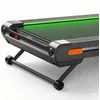
Best Value Walking Pad: Vitalwalk Apollo 11 Max
The steepest walking pad here, with auto incline to 20%, rated to 400 lb. Ignore the 3.5HP badge: the motor is rated 0.99 CHP continuous.$500 on Amazon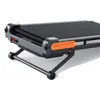
Best Budget Walking Pad: Vitalwalk Apollo 11 Vibe
The compact one: 15% auto incline on a pad that stores upright in 1.5 square feet. Brushless per the brand; not a motor I've opened.$297 on AmazonSpecs, teardown evidence and the full comparison table are on the walking pad page.
Manual Treadmills Not Recommended for Desk Use
Several gym-tier conditioning machines surface in "manual treadmill" searches but are built for sprint training, HIIT, or sled-push work - not all-day walking. Most share a structural disqualifier: the rails can't come off, or removing them leaves a control the machine needs at a setting you can't walk on. A console that only shows stats doesn't count against a machine. The Sunny SF-X7110 is the exception: its rails do come off, at the cost of its resistance control. Either way, the "skip the handrails at assembly" trick that converts the SB Fitness CT250 into an under-desk pad does not apply.
If you want one for running, the treadmill comparison covers curved trainers alongside motorized running treadmills.
- AssaultRunner (~$2,800 Classic) - CrossFit-tier curved-belt sprint trainer. 70" x 33" x 64" footprint, with structural handrail tubing that can't come off. Pro and Elite siblings share the same disqualifier.
- TrueForm Trainer ($3,495 Rubber / $4,095 Turf) - Wisconsin-built shallow-curve sprint trainer; the structural "Power Bar" front grab handle is built into the upright assembly, not a removable accessory. Premium sibling of the longer-deck Runner; same disqualifiers.
- Sunny SF-X7110 (~$2,500, 2026-10-06) - Misread as a walking-pad option because of the "8 magnetic resistance levels" marketing. Its uprights bolt on and the LCD only shows stats, but the tension knob rides the right upright, so going rails-off gives up resistance adjustment, and Sunny's manual doesn't say where resistance rests with the wire disconnected. Sunny themselves don't market it as under-desk.
- Sunny SF-T1407M (~$200) - Different failure mode: flat belt with a fixed 13.5% incline that forces you to grip the rails to walk uphill. The handrails aren't removable either: the two upright posts are structural to the frame.
- Lyan Hans 4-Level ($1,599.88) and Efficraft 8-Level ($1,849.99) - Two near-identical no-name curved air runners that crowd the cheap end of "manual treadmill" results. Both fail the same way: the uprights are continuous frame members, so the rails can't come off (only the outer U-loop handrails bolt off), and the resistance knob sits on them. On the Lyan Hans the knob is cable-actuated down the upright to the deck brake, and its listing rates the machine to 25 km/h (15.5 mph), double our walking ceiling. Neither brand has a working website.
- Bells of Steel Blitz (~$5,000) - Curved-belt with 6 magnetic-resistance levels and a sled-push handle. Brand markets it for "walk, jog, sprint, or sled push" - walking is one of six modes, not the design intent. The handrail assembly comes off, but the manual says resistance defaults to level 6, the hardest, until the tension wire on the right upright is connected.
- Bells of Steel Dreadmill (~$2,350) - Lower-priced sibling of the Blitz, with loadable weight horns and farmer-walk handles for sled-push conditioning work. Different geometry, though: a flat belt bolted at a fixed incline, the kind you grip the rails to walk against, and its resistance controller rides the right handrail tube.
All eight appear in the comparison table so you can see exactly how the specs land alongside the desk-friendly picks.
Where a control is mounted is an image check, not a copy check. Efficraft's listing advertises a "side-mounted tension knob", which reads as deck-mounted; the vendor's own product photos show the dial on the handrail crossbar. If a listing's rails story is the reason you're considering it, confirm it from the photographs.
Does a Manual Treadmill Affect Focus?
A common concern: won't actively propelling a treadmill belt distract you from work? Research suggests the opposite.
A Stanford study found creative output increased 60% while walking. Mayo Clinic research showed improved reasoning scores on active workstations with no drop in job performance. For people with ADHD the effect is sharper: UC Davis research found that movement helps maintain focus as attention wanes, and a Frontiers in Psychology study showed faster reaction times and fewer errors while walking compared to sitting.
Manual pads add a layer of light cognitive engagement beyond electric pads - you set the rhythm yourself instead of passively keeping pace with a motor. Some users find that easier to tune out than motor hum; others need a few days to adjust. If you have access to a coworking space with a Walkolution, try it before buying.
Which Manual Walking Pad Should You Buy?
| Your Situation | Best Option |
|---|---|
| Can wait on a pre-order | Office Walker (~$1,471 via Kickstarter late pledge, first units shipping now; public store Jan 2027), top pick overall |
| Want steel curved-belt you can order today | SB Fitness CT250 (~$1,000), US-based brand, skip the handrails at assembly |
| Were waiting on the ERGOLIFE or the RongLe | Both discontinued - the ERGOLIFE Curved ( |
| Money no object, want German beech | Walkolution 2 (~$3,000+, standard slats in stock) |
| Under $1,000 | Electric walking pad - the manual category now starts at ~$1,000, now that the ~$700 entries are discontinued |
Manual pads are the long-term play: a decade-plus lifespan, no motor to burn out, nothing to lubricate. The Office Walker at ~$1,471 is the cleanest entry point. The RongLe QZD-103-XJ at about $700 set the floor of the category until it was discontinued, which is why that floor now reads ~$1,000. The cheapest of the four you can order today is the SB Fitness CT250 at ~$1,000.